Sunday, 22 November 2009
100 Things Geo Meme - additional
17. Living and fossilized stromatolites Yep. They took us to see some at Summer School in 2009!

Whoops!
Nearly a year went by there without posting in here at all. I have some back-dated things that I need to log, so I'll get onto that and it won't look so bad!
In the meantime, I have subscribed to Deposits Magazine, which is fabulous, after getting myself a free sample copy back in July. It's already mnaged to clear up some issues I had with some of the terminology from Summer School. I now grasp exactly what / how hardground is formed. I mean, they showed it to us at School, but it wasn't clearly described. I don't think one person there just said "formed during times of low sedimentation rates."
*headdesk* it's all so obvious when pointed out in simple language.
The last local booksale was a bit of a waste of time, but I did manage to pick up a cheap copy of The Discovery of Evolution. Currently reading it on the loo - like you needed to know that...
In the meantime, I have subscribed to Deposits Magazine, which is fabulous, after getting myself a free sample copy back in July. It's already mnaged to clear up some issues I had with some of the terminology from Summer School. I now grasp exactly what / how hardground is formed. I mean, they showed it to us at School, but it wasn't clearly described. I don't think one person there just said "formed during times of low sedimentation rates."
*headdesk* it's all so obvious when pointed out in simple language.
The last local booksale was a bit of a waste of time, but I did manage to pick up a cheap copy of The Discovery of Evolution. Currently reading it on the loo - like you needed to know that...
Saturday, 7 November 2009
Isle of Wight
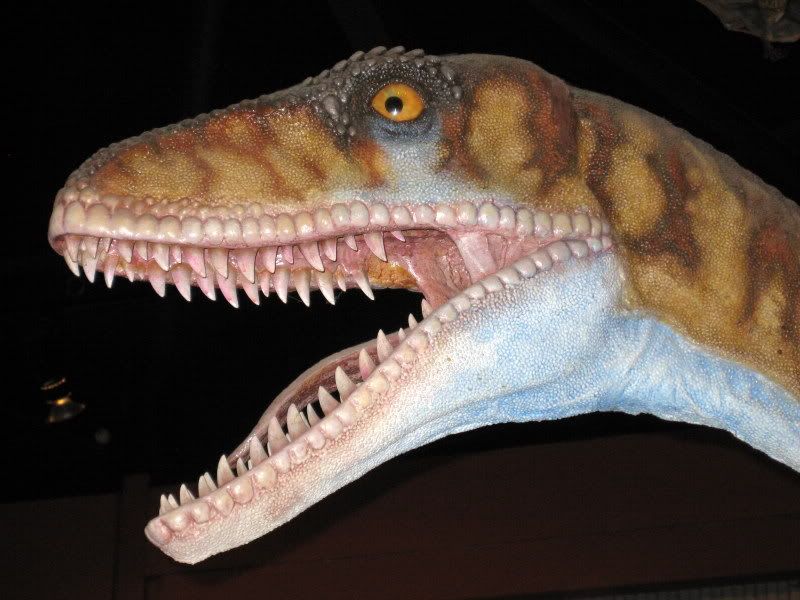
Unfortunately we went over a weekend when the tides were annoyingly high for most of the day, so there was no rock-bothering to be done or dinosaur footprints to find. Instead, we made up for it by going to Dinosaur Isle and looking at the fossils and the models.

Wednesday, 4 November 2009
Friday, 31 July 2009
Howick
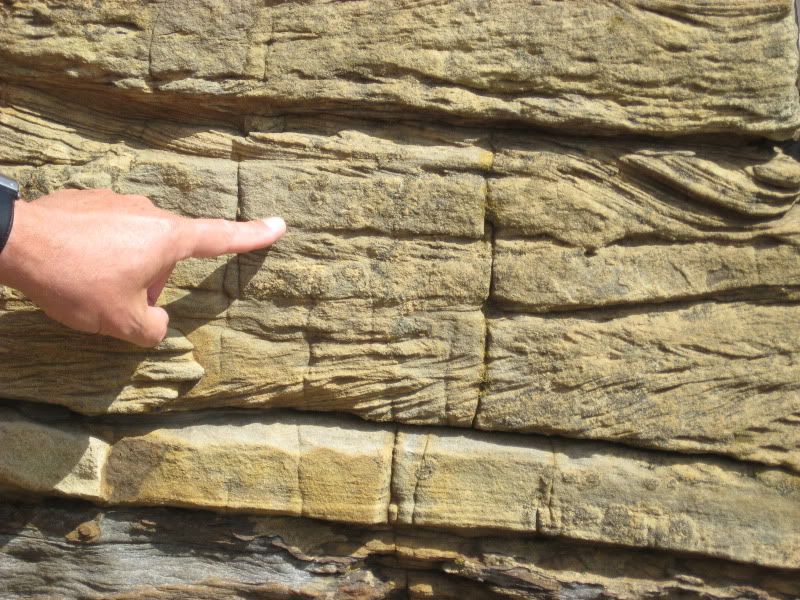
{click to enlarge}
Herring bone cross stratification. They told us that this is rare and this particular area is a very good example.
Wednesday, 29 July 2009
Scremerston
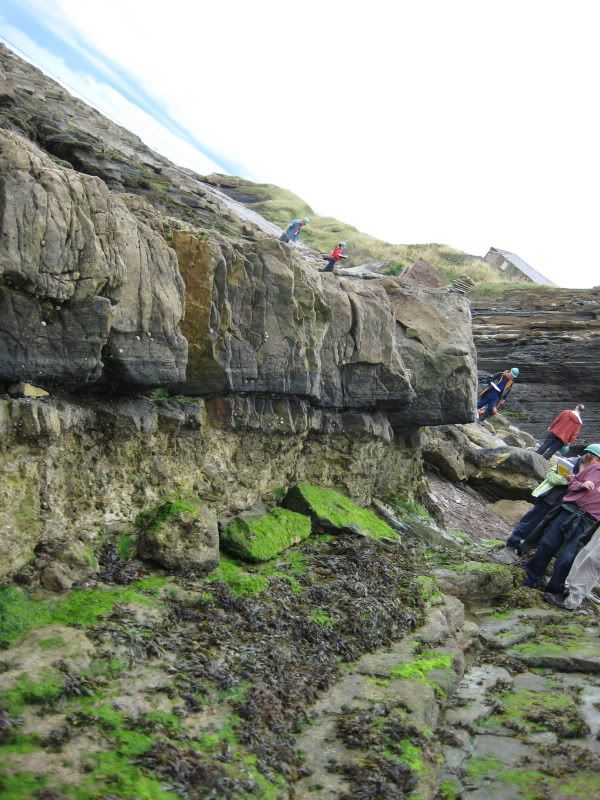
Graphic logging day at Scremerston. This was my section:

{click pic for larger}
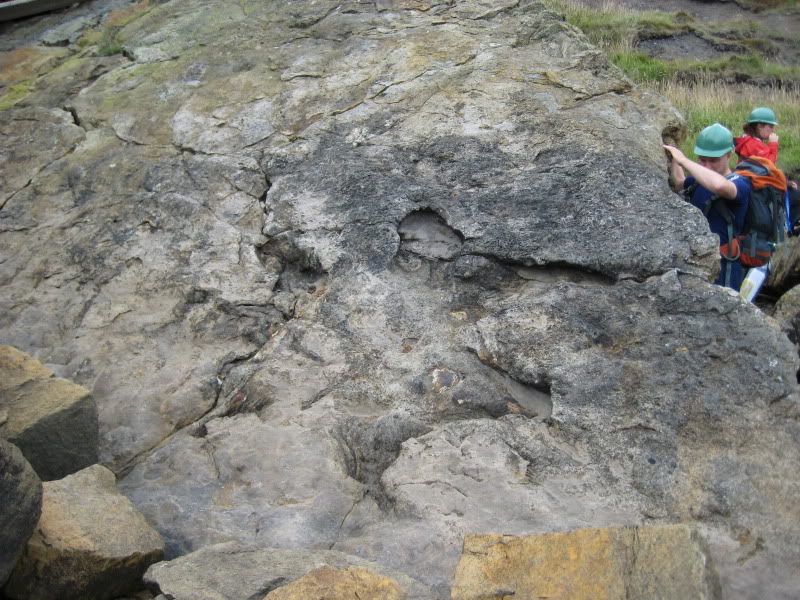
It wasn't as exciting as the next one up:

{click pic for larger}
Lepidodendron root ball!!!
{click pic for larger}
It wasn't as exciting as the next one up:
{click pic for larger}
Lepidodendron root ball!!!
Saturday, 20 December 2008
Christmas Carol
I find it very amusing that a Christmas Carol supposedly about the birth of Christ is actually about the birth of Bonnie Prince Charlie!
Oh Come Let Us Adore Him!
Oh Come Let Us Adore Him!
Monday, 15 December 2008
100 Things Meme - Geo Version
Pinched this from all over what seems to be called "The GeoBlogoSphere". It does seem a bit biased towards North America, but not to worry. I've only being doing this a few years, so I expect I'll get a pretty minimal score, but it's nice to see what is out there to be seen in the future.
Bold the ones that you've done:
1. See an erupting volcano
2. See a glacier
3. See an active geyser
(Yellowstone, New Zealand or the type locality of Iceland)
4. Visit the Cretaceous/Tertiary (KT) Boundary - I saw this on a summer school trip. Newhaven, East Sussex.
(Possible locations include Gubbio, Italy, Stevns Klint, Denmark, the Red Deer River Valley near Drumheller, Alberta.)
5. Observe (from a safe distance) a river whose discharge is above bankful stage
6. Explore a limestone cave - turns out that Wookey Hole is a limestone cave and therefore counts. I've tourned one in Spain as well, but can't recall the name
(Try Carlsbad Caverns in New Mexico, Lehman Caves in Great Basin National Park, or the caves of Kentucky)
7. Tour an open pit mine - I had to Google this to why this was different to quarries. Well, by the looks of things it isn't. So I've done field trips to mines twice.
(Such as those in Butte, Montana, Bingham Canyon, Utah, Summitville, Colorado, Globe or Morenci, Arizona, or Chuquicamata, Chile.)
8. Explore a subsurface mine - they took us to one in Cornwall when I was at school!
9. See an ophiolite, such as the ophiolite complex in Oman or the Troodos complex on the Island Cyprus (if on a budget, try the Coast Ranges or Klamath Mountains of California).
10. An anorthosite complex, such as those in Labrador, the Adirondacks, and Niger (there's some anorthosite in southern California too).
11. A slot canyon - Zion National Park, Utah. Just stumbled across one with nobody around, so I've actually pee'd in slot canyon!
(Many of these amazing canyons are less than 3 feet wide and over 100 feet deep. They reside on the Colorado Plateau. Among the best are Antelope Canyon, Brimstone Canyon, Spooky Gulch and the Round Valley Draw.)
12. Varves, whether you see the type section in Sweden or examples elsewhere.
13. An exfoliation dome, such as those in the Sierra Nevada.
14. A layered igneous intrusion, such as the Stillwater complex in Montana or the Skaergaard Complex in Eastern Greenland.
15. Coastlines along the leading and trailing edge of a tectonic plate
16. A gingko tree - ooo! Typo! They mean a Ginkgo biloba, of course...
which is the lone survivor of an ancient group of softwoods that covered much of the Northern Hemisphere in the Mesozoic.
17. Living and fossilized stromatolites Yep. They took us to see some at Summer School in 2009!
(Glacier National Park is a great place to see fossil stromatolites, while Shark Bay in Australia is the place to see living ones)
18. A field of glacial erratics
19. A caldera
20. A sand dune more than 200 feet high
21. A fjord
22. A recently formed fault scarp
23. A megabreccia
24. An actively accreting river delta
25. A natural bridge
26. A large sinkhole - not seen a large one
27. A glacial outwash plain
28. A sea stack - The Needles! Then they showed us one at Summer School in '09.
29. A house-sized glacial erratic - how big does the house have to be? I've seen shed-sized...
30. An underground lake or river - the River Axe flows through Wookey Hole, so I'm guessing that this one is a yes
31. The continental divide - just ticked this one off back in October!
32. Fluorescent and phosphorescent minerals - in musuems, not kicking around on the ground! Geology Museum in Barcelona a couple of weeks ago was the most recent.
33. Petrified trees - Petrified Forest, Arizona
34. Lava tubes - they were collapsed, but I'm counting them
35. The Grand Canyon - with all those warnings about how the super-fit can die going down in the canyon? No thank you. I'm counting it because I've been there twice now AND done the North Rim.
(All the way down. And back.)
36. Meteor Crater, Arizona - YAY!!!! I'd wanted to see this for such a long time!!!
(also known as the Barringer Crater, to see an impact crater on a scale that is comprehensible)
37. The Great Barrier Reef, northeastern Australia, to see the largest coral reef in the world.
38. The Bay of Fundy, New Brunswick and Nova Scotia, Canada, to see the highest tides in the world (up to 16m)
39. The Waterpocket Fold, Utah, to see well exposed folds on a massive scale.
40. The Banded Iron Formation, Michigan, to better appreciate the air you breathe.
41. The Snows of Kilimanjaro, Tanzania,
42. Lake Baikal, Siberia, to see the deepest lake in the world (1,620 m) with 20 percent of the Earth's fresh water.
43. Ayers Rock (known now by the Aboriginal name of Uluru), Australia. This inselberg of nearly vertical Precambrian strata is about 2.5 kilometers long and more than 350 meters high
44. Devil's Tower, northeastern Wyoming, to see a classic example of columnar jointing (I've seen some of that!)
45. The Alps - something European? Careful there, list-maker.
46. Telescope Peak, in Death Valley National Park. From this spectacular summit you can look down onto the floor of Death Valley - 11,330 feet below.
47. The Li River, China, to see the fantastic tower karst that appears in much Chinese art
48. The Dalmation Coast of Croatia, to see the original Karst.
49. The Gorge of Bhagirathi, one of the sacred headwaters of the Ganges, in the Indian Himalayas, where the river flows from an ice tunnel beneath the Gangatori Glacier into a deep gorge.
50. The Goosenecks of the San Juan River, Utah, an impressive series of entrenched meanders.
51. Shiprock, New Mexico, to see a large volcanic neck
52. Land's End, Cornwall, Great Britain, for fractured granites that have feldspar crystals bigger than your fist.
53. Tierra del Fuego, Chile and Argentina, to see the Straights of Magellan and the southernmost tip of South America.
54. Mount St. Helens, Washington, to see the results of recent explosive volcanism.
55. The Giant's Causeway and the Antrim Plateau, Northern Ireland, to see polygonally fractured basaltic flows.
56. The Great Rift Valley in Africa.
57. The Matterhorn, along the Swiss/Italian border, to see the classic "horn".
58. The Carolina Bays, along the Carolinian and Georgian coastal plain
59. The Mima Mounds near Olympia, Washington
60. Siccar Point, Berwickshire, Scotland, where James Hutton (the "father" of modern geology) observed the classic unconformity
61. The moving rocks of Racetrack Playa in Death Valley
62. Yosemite Valley
63. Landscape Arch (or Delicate Arch) in Utah
64. The Burgess Shale in British Columbia
65. The Channeled Scablands of central Washington
66. Bryce Canyon
67. Grand Prismatic Spring at Yellowstone
68. Monument Valley
69. The San Andreas fault
70. The dinosaur footprints in La Rioja, Spain
71. The volcanic landscapes of the Canary Islands
72. The Pyrennees Mountains
73. The Lime Caves at Karamea on the West Coast of New Zealand
74. Denali (an orogeny in progress)
75. A catastrophic mass wasting event
76. The giant crossbeds visible at Zion National Park. Love, Love, LOVE!
77. The black sand beaches in Hawaii (or the green sand-olivine beaches)
78. Barton Springs in Texas
79. Hells Canyon in Idaho
80. The Black Canyon of the Gunnison in Colorado
81. The Tunguska Impact site in Siberia
82. Feel an earthquake with a magnitude greater than 5.0.
83. Find dinosaur footprints in situ
84. Find a trilobite (or a dinosaur bone or any other fossil) - many belemnites/ammonites/brachiopods/traces etc
85. Find gold, however small the flake
86. Find a meteorite fragment
87. Experience a volcanic ashfall
88. Experience a sandstorm
89. See a tsunami
90. Witness a total solar eclipse
91. Witness a tornado firsthand. (Important rules of this game).
92. Witness a meteor storm, a term used to describe a particularly intense (1000+ per minute) meteor shower
93. View Saturn and its moons through a respectable telescope.
94. See the Aurora borealis, otherwise known as the northern lights.
95. View a great naked-eye comet, an opportunity which occurs only a few times per century
96. See a lunar eclipse
97. View a distant galaxy through a large telescope
98. Experience a hurricane
99. See noctilucent clouds
100. See the green flash
Sadly, a mere 26 things. In fact, I'm pretty lucky that I did that road trip with my Dad in October, as at least 6 items on this list were ticked off then! I'm not sure I want to do some of them, I'll happily continue without being in a hurricane, tornado, sandstorm or be near a tsunami etc. It looks like a tour of The Canyons of America will get most of this list done and dusted!
Bold the ones that you've done:
1. See an erupting volcano
2. See a glacier
3. See an active geyser
(Yellowstone, New Zealand or the type locality of Iceland)
4. Visit the Cretaceous/Tertiary (KT) Boundary - I saw this on a summer school trip. Newhaven, East Sussex.
(Possible locations include Gubbio, Italy, Stevns Klint, Denmark, the Red Deer River Valley near Drumheller, Alberta.)
5. Observe (from a safe distance) a river whose discharge is above bankful stage
6. Explore a limestone cave - turns out that Wookey Hole is a limestone cave and therefore counts. I've tourned one in Spain as well, but can't recall the name
(Try Carlsbad Caverns in New Mexico, Lehman Caves in Great Basin National Park, or the caves of Kentucky)
7. Tour an open pit mine - I had to Google this to why this was different to quarries. Well, by the looks of things it isn't. So I've done field trips to mines twice.
(Such as those in Butte, Montana, Bingham Canyon, Utah, Summitville, Colorado, Globe or Morenci, Arizona, or Chuquicamata, Chile.)
8. Explore a subsurface mine - they took us to one in Cornwall when I was at school!
9. See an ophiolite, such as the ophiolite complex in Oman or the Troodos complex on the Island Cyprus (if on a budget, try the Coast Ranges or Klamath Mountains of California).
10. An anorthosite complex, such as those in Labrador, the Adirondacks, and Niger (there's some anorthosite in southern California too).
11. A slot canyon - Zion National Park, Utah. Just stumbled across one with nobody around, so I've actually pee'd in slot canyon!
(Many of these amazing canyons are less than 3 feet wide and over 100 feet deep. They reside on the Colorado Plateau. Among the best are Antelope Canyon, Brimstone Canyon, Spooky Gulch and the Round Valley Draw.)
12. Varves, whether you see the type section in Sweden or examples elsewhere.
13. An exfoliation dome, such as those in the Sierra Nevada.
14. A layered igneous intrusion, such as the Stillwater complex in Montana or the Skaergaard Complex in Eastern Greenland.
15. Coastlines along the leading and trailing edge of a tectonic plate
16. A gingko tree - ooo! Typo! They mean a Ginkgo biloba, of course...
which is the lone survivor of an ancient group of softwoods that covered much of the Northern Hemisphere in the Mesozoic.
17. Living and fossilized stromatolites Yep. They took us to see some at Summer School in 2009!
(Glacier National Park is a great place to see fossil stromatolites, while Shark Bay in Australia is the place to see living ones)
18. A field of glacial erratics
19. A caldera
20. A sand dune more than 200 feet high
21. A fjord
22. A recently formed fault scarp
23. A megabreccia
24. An actively accreting river delta
25. A natural bridge
26. A large sinkhole - not seen a large one
27. A glacial outwash plain
28. A sea stack - The Needles! Then they showed us one at Summer School in '09.
29. A house-sized glacial erratic - how big does the house have to be? I've seen shed-sized...
30. An underground lake or river - the River Axe flows through Wookey Hole, so I'm guessing that this one is a yes
31. The continental divide - just ticked this one off back in October!
32. Fluorescent and phosphorescent minerals - in musuems, not kicking around on the ground! Geology Museum in Barcelona a couple of weeks ago was the most recent.
33. Petrified trees - Petrified Forest, Arizona
34. Lava tubes - they were collapsed, but I'm counting them
35. The Grand Canyon - with all those warnings about how the super-fit can die going down in the canyon? No thank you. I'm counting it because I've been there twice now AND done the North Rim.
(All the way down. And back.)
36. Meteor Crater, Arizona - YAY!!!! I'd wanted to see this for such a long time!!!
(also known as the Barringer Crater, to see an impact crater on a scale that is comprehensible)
37. The Great Barrier Reef, northeastern Australia, to see the largest coral reef in the world.
38. The Bay of Fundy, New Brunswick and Nova Scotia, Canada, to see the highest tides in the world (up to 16m)
39. The Waterpocket Fold, Utah, to see well exposed folds on a massive scale.
40. The Banded Iron Formation, Michigan, to better appreciate the air you breathe.
41. The Snows of Kilimanjaro, Tanzania,
42. Lake Baikal, Siberia, to see the deepest lake in the world (1,620 m) with 20 percent of the Earth's fresh water.
43. Ayers Rock (known now by the Aboriginal name of Uluru), Australia. This inselberg of nearly vertical Precambrian strata is about 2.5 kilometers long and more than 350 meters high
44. Devil's Tower, northeastern Wyoming, to see a classic example of columnar jointing (I've seen some of that!)
45. The Alps - something European? Careful there, list-maker.
46. Telescope Peak, in Death Valley National Park. From this spectacular summit you can look down onto the floor of Death Valley - 11,330 feet below.
47. The Li River, China, to see the fantastic tower karst that appears in much Chinese art
48. The Dalmation Coast of Croatia, to see the original Karst.
49. The Gorge of Bhagirathi, one of the sacred headwaters of the Ganges, in the Indian Himalayas, where the river flows from an ice tunnel beneath the Gangatori Glacier into a deep gorge.
50. The Goosenecks of the San Juan River, Utah, an impressive series of entrenched meanders.
51. Shiprock, New Mexico, to see a large volcanic neck
52. Land's End, Cornwall, Great Britain, for fractured granites that have feldspar crystals bigger than your fist.
53. Tierra del Fuego, Chile and Argentina, to see the Straights of Magellan and the southernmost tip of South America.
54. Mount St. Helens, Washington, to see the results of recent explosive volcanism.
55. The Giant's Causeway and the Antrim Plateau, Northern Ireland, to see polygonally fractured basaltic flows.
56. The Great Rift Valley in Africa.
57. The Matterhorn, along the Swiss/Italian border, to see the classic "horn".
58. The Carolina Bays, along the Carolinian and Georgian coastal plain
59. The Mima Mounds near Olympia, Washington
60. Siccar Point, Berwickshire, Scotland, where James Hutton (the "father" of modern geology) observed the classic unconformity
61. The moving rocks of Racetrack Playa in Death Valley
62. Yosemite Valley
63. Landscape Arch (or Delicate Arch) in Utah
64. The Burgess Shale in British Columbia
65. The Channeled Scablands of central Washington
66. Bryce Canyon
67. Grand Prismatic Spring at Yellowstone
68. Monument Valley
69. The San Andreas fault
70. The dinosaur footprints in La Rioja, Spain
71. The volcanic landscapes of the Canary Islands
72. The Pyrennees Mountains
73. The Lime Caves at Karamea on the West Coast of New Zealand
74. Denali (an orogeny in progress)
75. A catastrophic mass wasting event
76. The giant crossbeds visible at Zion National Park. Love, Love, LOVE!
77. The black sand beaches in Hawaii (or the green sand-olivine beaches)
78. Barton Springs in Texas
79. Hells Canyon in Idaho
80. The Black Canyon of the Gunnison in Colorado
81. The Tunguska Impact site in Siberia
82. Feel an earthquake with a magnitude greater than 5.0.
83. Find dinosaur footprints in situ
84. Find a trilobite (or a dinosaur bone or any other fossil) - many belemnites/ammonites/brachiopods/traces etc
85. Find gold, however small the flake
86. Find a meteorite fragment
87. Experience a volcanic ashfall
88. Experience a sandstorm
89. See a tsunami
90. Witness a total solar eclipse
91. Witness a tornado firsthand. (Important rules of this game).
92. Witness a meteor storm, a term used to describe a particularly intense (1000+ per minute) meteor shower
93. View Saturn and its moons through a respectable telescope.
94. See the Aurora borealis, otherwise known as the northern lights.
95. View a great naked-eye comet, an opportunity which occurs only a few times per century
96. See a lunar eclipse
97. View a distant galaxy through a large telescope
98. Experience a hurricane
99. See noctilucent clouds
100. See the green flash
Sadly, a mere 26 things. In fact, I'm pretty lucky that I did that road trip with my Dad in October, as at least 6 items on this list were ticked off then! I'm not sure I want to do some of them, I'll happily continue without being in a hurricane, tornado, sandstorm or be near a tsunami etc. It looks like a tour of The Canyons of America will get most of this list done and dusted!
Tuesday, 18 November 2008
Stratigraphy!
Well, I found a great site for time-wasting in the name of stratigraphic sequences. ThisIsSand.com. You can have any colour of sand you like and build it up into lovely mountains and then fill in the valleys.
The sound of rushing sand gets a bit annoying after a while, but it's great stuff.
The sound of rushing sand gets a bit annoying after a while, but it's great stuff.
Wednesday, 5 November 2008
YES!!!!
 Well done America, you made the right choice. The polar bears and Drosophila melanogaster thank you.
Friday, 19 September 2008
Archaeology Course
Pass. From the look of it (and in true OU short course fashion the feedback is blah) I am very good at ethical considerations, good at arithmetic, graphical methods, knowledge of archaeological processes and analysing scientific information. Seems that my descriptions could use some work and expressing things in my own way.
This course is half science and half arts. All the science stuff I'm good at, descriptive artsy waffle I'm not good at. I'm turning into a science student and abandoning the arts. This is not a bad thing.
No more arts courses.
S369 is next up. Is it February yet?
This course is half science and half arts. All the science stuff I'm good at, descriptive artsy waffle I'm not good at. I'm turning into a science student and abandoning the arts. This is not a bad thing.
No more arts courses.
S369 is next up. Is it February yet?
Wednesday, 10 September 2008
Mineral Meme
(I need to keep that genius level...)
Pinched from Lounge of the Lab Lemming
50 minerals everyone should see:
Andalusite
Apatite
Barite
Beryl
Biotite
Chromite
Chrysotile
Cordierite
Corundum
Diamond
Dolomite
Florencite - (never even heard of that one!)
Galena
Garnet
Graphite
Gypsum
Halite
Hematite
Hornblende
Illite
Illmenite
Kaolinite - (possibly, it's in Lizardite, which I have seen in situ)
Kyanite
Lepidolite
Limonite
Magnetite
Molybdenite
Monazite
Nepheline
Olivine
Omphacite
Opal
Perovskite
Plagioclase
Pyrite
Quartz
Rutile
Sanidine
Sillimanite
Silver (native)
Sphalerite
Staurolite
Sulphur (native)
Talc
Tourmaline
Tremolite
Turquoise
Vermiculite
Willemite
Zeolite
Zircon
I wonder how many of these I've seen without realising it? Maybe I should start making a note of the minerals I see. Ticky book!
EDIT: ticked a few more off after paying attention at a couple of Geo Museums!
Pinched from Lounge of the Lab Lemming
Use bold to indicate minerals you’ve seen in the wild. Italics is for those seen in laboratories, museums, stores, or other non field locations. Ex pet nerds may use underlining to indicate those that they’ve grown with their own two hands. And I won’t bother with stuff you intend on seeing- if you didn’t want to see all these minerals yourself, you’d be spending your precious lunch hour on a physics or biomedical blog.
50 minerals everyone should see:
Andalusite
Apatite
Barite
Beryl
Biotite
Chromite
Chrysotile
Cordierite
Corundum
Diamond
Dolomite
Florencite - (never even heard of that one!)
Galena
Garnet
Graphite
Gypsum
Halite
Hematite
Hornblende
Illite
Illmenite
Kaolinite - (possibly, it's in Lizardite, which I have seen in situ)
Kyanite
Lepidolite
Limonite
Magnetite
Molybdenite
Monazite
Nepheline
Olivine
Omphacite
Opal
Perovskite
Plagioclase
Pyrite
Quartz
Rutile
Sanidine
Sillimanite
Silver (native)
Sphalerite
Staurolite
Sulphur (native)
Talc
Tourmaline
Tremolite
Turquoise
Vermiculite
Willemite
Zeolite
Zircon
I wonder how many of these I've seen without realising it? Maybe I should start making a note of the minerals I see. Ticky book!
EDIT: ticked a few more off after paying attention at a couple of Geo Museums!
So funny!
It looks as if my Blog Reading Level has gone up!

This amuses me greatly!
EDIT NOV 09: Looks like the site might be down or stopped working. Still, this result was "Genius" and therefore amusing.
This amuses me greatly!
EDIT NOV 09: Looks like the site might be down or stopped working. Still, this result was "Genius" and therefore amusing.
Of Fossils & Chocolate...
I've been watching the Fossil Detectives on BBC4, which is quite interesting and definitely pitched by the Beeb/OU at Level 1, but I also ordered the Field Guide that accompanies the series and it's full of brilliant diagrams and helpful timelines. Perfect for revision.
Still reading the extremely cute blog by "Tym the Trilobite"
The market is still selling trilobites, but they're getting pricier. Lots of phacops, no more calymene (I don't have one of those) and only one with a gorgeous headshield (paradoxidies again, I'm guessing). He's about three inches long and has perfectly preserved detailing. They didn't know what he was thogh, which is a shame and would put me off buying him. Well, that and the fact that he cost £50! Still, I had just spent £50 in Boots... maybe I should straighten out my priorities and spend my hard-earned monies on fossils instead.
I did find a fabulous ammonite today. Yummy milk chocolatey goodness in Hotel Chocolat.
Still reading the extremely cute blog by "Tym the Trilobite"
The market is still selling trilobites, but they're getting pricier. Lots of phacops, no more calymene (I don't have one of those) and only one with a gorgeous headshield (paradoxidies again, I'm guessing). He's about three inches long and has perfectly preserved detailing. They didn't know what he was thogh, which is a shame and would put me off buying him. Well, that and the fact that he cost £50! Still, I had just spent £50 in Boots... maybe I should straighten out my priorities and spend my hard-earned monies on fossils instead.
I did find a fabulous ammonite today. Yummy milk chocolatey goodness in Hotel Chocolat.
Wednesday, 13 August 2008
Tym the Trilobite!
Awesome content from the BBC this week, Fossil Detectives featuring a blog by Tym the Trilobite. It looks like he's supposed to be a Paradoxides davidis, which is the one I was after at the local market last year. Damn, I wish I'd bought him now.
Monday, 30 June 2008
Doctor Horrible's Sing-Along Blog
This isn't anything to do with my Adventures in Science, BUT does feature Neil Patrick Harris of Doogie Howser fame playing another Doctor - which is scientific! Besides, Joss Whedon told us to link to it anywhere we could - so I am. Who am I to refuse the Great Joss Whedon?

* Part 1 - Tuesday July 15
* Part 2 - Thursday July 17
* Part 3 - Saturday July 19
* Part 1 - Tuesday July 15
* Part 2 - Thursday July 17
* Part 3 - Saturday July 19
Friday, 16 May 2008
The Harris Matrix & Nudibranchs
Yesterday a link on my new course forum directed us to download Principles of Archaelogical Stratigraphy by Dr Edward Harris, which has been out of print for ages and was expensive when it was in print. The author decided that it should be freely available to anyone who wanted it. I'm not sure I'm going to read a book entirely about archaeological stratigraphy, but it does have a short chapter on geological stratigraphy, so that, at least, should be interesting.
You have to fill in a box saying exactly why you want it, but I assumed it was one of those online forms that nobody ever reads. However, this morning I find an email from Dr Harris wishing me luck on my course, hoping I'll enjoy his book and sending a bunch of pictures. One of him and his book, one of the first stratigraphic sequence ever done in archaeology and the view from his house - he lives in Bermuda, so his view is pretty special. Very bizarre.
Although not as bizarre as one of the links I had on my Google Reader today. The National Geographic seems to think that I need to start my day with Nudibranchs. In case you've never seen a Nudibranch before here's a pair:
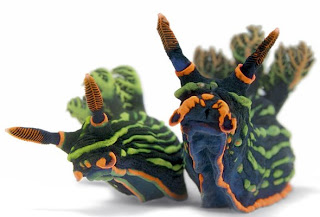
Nudibranch Gallery. I think my favourite is probably Chromodoris annae, so cute and blue and stripey. Although the expression on the face of Bornella anguilla is adorable and just asking to be made into a LOLnudibranch!
You have to fill in a box saying exactly why you want it, but I assumed it was one of those online forms that nobody ever reads. However, this morning I find an email from Dr Harris wishing me luck on my course, hoping I'll enjoy his book and sending a bunch of pictures. One of him and his book, one of the first stratigraphic sequence ever done in archaeology and the view from his house - he lives in Bermuda, so his view is pretty special. Very bizarre.
Although not as bizarre as one of the links I had on my Google Reader today. The National Geographic seems to think that I need to start my day with Nudibranchs. In case you've never seen a Nudibranch before here's a pair:

Nudibranch Gallery. I think my favourite is probably Chromodoris annae, so cute and blue and stripey. Although the expression on the face of Bornella anguilla is adorable and just asking to be made into a LOLnudibranch!
Wednesday, 14 May 2008
The Blog Readability Test
I did this back in February and it came back as "Elementary School". I must have used a few bigger words since then!

Archaeology
New course. Doesn't actually start officially until Saturday, but the books arrived last Tuesday so I've been stuck in for a week. Started my ECA yesterday as well, go me and my enthusiasm.
The course is based round three excavation sites. One is Tell es-Sa'idiyeh, which is a bugger to pronounce and one is "Wetwang Woman", which is far too amusing. Still, so far so good.
It's also a course that will count towards the GeoScience degree, so it's nice to be doing something 'proper' again after all that Leonardo da Vinci crap.
The course is based round three excavation sites. One is Tell es-Sa'idiyeh, which is a bugger to pronounce and one is "Wetwang Woman", which is far too amusing. Still, so far so good.
It's also a course that will count towards the GeoScience degree, so it's nice to be doing something 'proper' again after all that Leonardo da Vinci crap.
Wednesday, 16 April 2008
Leonardo is all Over
Assignment... *insert Gordon Ramsey back hand slap* ...DONE!
However, as it's not due until Friday week I'm not going to send it off yet. There's a BBC4 program on tomorrow night called Inside the Medieval Mind, which may have a startling insight / useful bibliography-expanding quote that I could use. Perhaps something fresh will come to me as I stare out of train windows on Friday and Monday. It would be rather annoying to submit it and then have a moment of revalation. If nothing is revealed to me, then I'm happy to submit what I have and happily turn my back on him once and for all.
I'll have a couple of weeks then before Archaeology: The Science of Investiagtion starts (unless the books arrive early) and I can read some of those yummy Earth Sciencey books I have.
However, as it's not due until Friday week I'm not going to send it off yet. There's a BBC4 program on tomorrow night called Inside the Medieval Mind, which may have a startling insight / useful bibliography-expanding quote that I could use. Perhaps something fresh will come to me as I stare out of train windows on Friday and Monday. It would be rather annoying to submit it and then have a moment of revalation. If nothing is revealed to me, then I'm happy to submit what I have and happily turn my back on him once and for all.
I'll have a couple of weeks then before Archaeology: The Science of Investiagtion starts (unless the books arrive early) and I can read some of those yummy Earth Sciencey books I have.
Subscribe to:
Posts (Atom)